
Australia is known to many of us as the lucky country. But when it comes to skin cancers, it is anything but lucky.
Melanoma is the third most common cancer in Australia overall, only behind breast and prostate cancer. While it strikes people of any age, it is the most common cancer among young Australians aged 20-39.
Melanoma is highly treatable when detected early, but if left untreated or diagnosed at an advanced stage, it can be deadly. London Agency reached out and spoke to members of the 47th Parliament about their own experiences battling the condition.
In recent times, Health Minister Mark Butler has described melanoma as our “national cancer,” launching programs with the Cancer Council and expanding the listings of nivolumab and ipilimumab on the Pharmaceutical Benefits Scheme (PBS) to treat Stage III or IV malignant melanoma in patients who experience a recurrence of melanoma while receiving or within 6 months of completing adjuvant PD-1 inhibitor monotherapy.
While these investments help many Australians, the story of melanoma is a deeply personal one to many in the 47th Parliament.
Labor’s Education Minister Jason Clare has been vocal about his own experience with the disease and how it affected him.
After the 2019 election, Minister Clare noticed that a mole on his leg seemed to have changed colour.
After an appointment with his dermatologist, the then 47-year-old father received the news we all dread. It was melanoma, it was malignant, it would require surgery to cut out.
Taking to X (formerly known as Twitter), Clare shared the aftermath of the surgery to remove the melanoma from his leg.
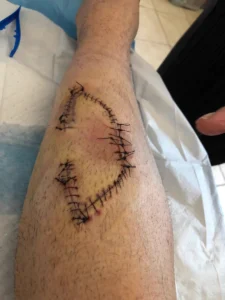
This is what skin cancer looks like. Stitches are out. Getting ready to go back to Parliament. Please slip, slop, slap this summer and get a skin check pic.twitter.com/HoFv28nRH8
— Jason Clare MP (@JasonClareMP) October 13, 2019
Nearly four and a half years on from his scare, Clare looks back on those moments.
“A couple of years ago, I got diagnosed with melanoma. I’m one of the lucky ones,” Clare told the ABC.
“I spotted a mole on my leg, which I noticed had changed colour. And so, I booked an appointment with the doctor. She said, “Okay, let’s cut it out.”
“We cut it out, and I’m so lucky that we did, because that decision to see her and cut it out saved my life. If melanomas are left on your body to grow, they metastasise and they spread to every part of your body, and it’ll kill you.”
“People come from overseas, and they’re all terrified about getting bitten by a crocodile or a shark. Melanoma kills one Aussie every six hours. This is a massive killer.”
Spurred on by his parliamentary colleague’s story, Moreton MP Graham Perrett decided it was time for him to get his own skin properly checked.
Sharing his experience with London Agency, Perrett remarked that melanoma is something that affects almost every Australian, be that directly or indirectly.
“There aren’t too many people out there that haven’t either been directly affected by cancer or knows someone who has,” Perrett said.
“I remember speaking with Jason Clare one day and he spoke about how he had just had a skin cancer removed from his leg.”
“Like most Australians I spent plenty of time in the sun growing up and had a mole on my chest which had worried me, but I hadn’t gotten it seen by a doctor.”
“After chatting with Jason, I went straight to the doctors, and had it removed. Luckily for me, they got it all just in time.”
Much like his fellow Queensland MP, Treasurer Jim Chalmers spent his early years growing up in the Queensland sun.
In early 2023, he shared the story of his own melanoma scare with radio station 2CC.
“Growing up as a kid in Queensland in the summer holidays you rarely have a shirt on, let alone sun cream,” Chalmers said “So you get a bit complacent about the sun and I got especially complacent about a mark that I had on my chest that had been there for a while.”
“I would see it when I was brushing my teeth at night and I just happened to be in the doctors talking about something else and while I think he was bashing me out a script on his keyboard, I said to him ‘What do you think about this guy here on my chest?”
“I could tell by the look on his face and by what he said subsequently, I needed to get it checked out.”
“It was a melanoma and I had to have it chopped out of my chest. Thankfully and by some stroke of luck, it wasn’t too late.”
When it comes to melanoma, it is an issue which extends beyond political parties. Former Deputy Prime Minister and Nationals MP Barnaby Joyce has also had his own battles with melanoma.
Speaking with London Agency, Joyce explained his own discovery of skin cancer.
“Unfortunately, I found out too late in life that my skin was perfectly designed for the west coast of Ireland and very badly designed for west of the great dividing ranges of Australia,” Joyce said.
“The price of my heroic short sleeve efforts, mustering, fencing, and doing general farm work or going to the beach was two diagnosed cases of melanoma in my late 40’s.”
Like many who catch melanoma early, Joyce’s journey was painful but survivable.
“I was so lucky, that I had a doctor who was vigilant enough to pick this up. In fact, he was a professor trying to raise awareness for melanoma in Parliament House,” Joyce remarked.
“It is indebted upon us to live longer than you will if you get diagnosed melanoma, and it is untreated.”
Whilst all of their stories may all be similar, the call to action is the same.
“We’ve got to take it seriously, we’ve got to be sun safe, but we’ve also got to make sure that we go to the doctor regularly and get a skin check,” said Clare.
“Don’t put it off, go and see your doctor or a skin specialist straight away, because it just may save your life,” said Perrett.
“I urge people – don’t put it off, get yourself checked out as soon as possible,” said Chalmers.
“Do it for your family, but most importantly do it for yourself,” said Joyce.
The majority of skin cancers are avoidable and curable, yet the cost to the Australian health economy is estimated at $1.7 billion each year.
The way these four MPs, as well as many more in Parliament are open about their own health issues helps to de-stigmatise some of Australia’s biggest health battles. It also shows why healthcare in Australia is not an abstract thought for many parliamentarians, it is a deeply personal passion.